

Bernese Mountain Dog
Group: Working Dog Group
Origin: Switzerland
Height:
- – Males: 24.5 in to 27.5 in (62-70 cm)
– Female: From 22.5 in to 26 in (58-66 cm)
Weight:
- – Males: From 85 to 120 lbs (39-55 kg)
– Females: From 65 to 100 lbs (30-45 kg)
Other Names: Bouvier Bernois; Berner Sennenhund
CLICK HERE to View Breeder Listings
Breed Profile
The Bernese Mountain Dog has a wonderful temperament. He is dependable, consistent, has a strong desire to please, and always appears to be in command of a situation. The Bernese is an excellent family companion. He is devoted, faithful, and affectionate to his family and requires plenty of human companionship. This is not a dog to be left outdoors but, rather, he must be made a full member of the family. He has a calm and gentle disposition which makes him very good with children and other animals. He may appear to be aloof or suspicious of strangers but is never aggressive or timid. The Bernese, however, is not a guard dog. While he may bark and appear intimidating, in general, the Bernese has a very friendly nature.
A very versatile breed, the Berner is seen competing in several areas, such as conformation, obedience, agility, tracking, herding, and carting. He is also quite often seen working as a Therapy Dog.
The Bernese is slow to mature physically and can take up to three years to reach full growth. Daily exercise is required to keep the adult dog fit and, like most large breeds, care must be taken to not over-exercise the young dog during the growing phase.
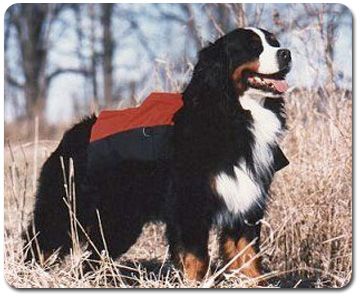
In appearance, the Bernese Mountain Dog is large, sturdy, strong, agile and well-balanced. The males appear distinctly masculine while the females are distinctly feminine. The tri-coloured, heavy, double coat has distinctive markings — The ground colour is jet-black with rich russet markings on the cheeks, a spot over each eye, a patch above the forelegs, and on all four legs between the black of the upper leg and the white of the feet. White markings are found on the chest to under the chin as well as a blaze extending into the muzzle band, white feet and a white tip of the tail. The coat is weather resistant and of moderate length with a natural sheen.
A Brief History of the Bernese Mountain Dog
The Bernese Mountain Dog is one of four varieties of Swiss mountain dogs. The other three are the Appenzeller Sennenhund, the Entlebucher Sennenhund, and the Greater Swiss Mountain Dog. Of the four breeds, the Bernese is the second largest (the Greater Swiss Mountaind Dog being the largest) and the only one to have a long coat. Their ancestors were Mastiffs that were brought into Switzerland more than 2,000 years ago. Inter-breeding with local farm dogs created a somewhat smaller but equally trustworthy dog. Originally, the Bernese was used to drive livestock and to pull carts of produce, primarily in Berne, Switzerland where he is known as Berner Sennenhund. The breed was brought to North America in the mid-1920’s. The breed was officially recognized by the American Kennel Club in 1937 and the United Kennel Club in 1948.
Additional Information on the History of the Breed:
- Breed History and Standard — From the Bernese Mountain Dog Club of America (BMDCA)
Health Issues
Unfortunately, the Bernese Mountain dog has a relatively short life expectancy with the average being 7 to 8 years. However, there are some who live 10 years or longer. The Swiss say: “Three years a young dog, three years a good dog, and three years an old dog…all else, a gift from God.” [Quoted from the BMDCSEW Puppy Buyer’s Guide.] Some of the health issues affecting this breed include hip and elbow dysplasia, cancer, bloat, sub-aortic stenosis, autoimmune diseases, thyroid disorders, eye diseases, and skin and coat problems. For more information regarding health issues for the Bernese Mountain Dog, see www.bernergarde.org – Berner-Garde Foundation.
If you are considering the adoption of a Bernese Mountain Dog puppy, or any breed, it is very important to be selective in choosing a responsible and reputable breeder. Ensure that the prospective puppy’s parents have all health clearances. (For more information on selecting a breeder, see the articles on the General Information page.)
Recommended Health Screening:
Health screenings for the Bernese Mountain Dog should include, among others, hip and elbow x-rays to exclude hip and elbow dysplasia and eyes should be checked to see that they are normal and PRA clear.
For the Bernese Mountain Dog, the CHICNote 1 database includes health screenings for:
- DNA Profile;
- VonWillebrand’s Disease;
- Hip Dysplasia;
- Elbow Dysplasia;
- Eye Examination by a board Ophthalmologist; and
- Congenital Cardiac Database
Additional Health Resources:
- Berner-Garde Foundation — Established to collect, maintain and disseminate information about genetic diseases observed in the Bernese Mountain Dog.
- Canine Inherited Disorders Database — Bernese Mountain Dog
- Canine Health Information Center (CHIC) — Bernese Mountain Dog Breeds Requirements — Providing a source of health information for owners, breeders, and scientists that will assist in breeding healthy dogs. CHIC is a centralized canine health database jointly sponsored by the AKC/Canine Health Foundation (AKC/CHF) and the Orthopedic Foundation for Animals (OFA).
- Health and Nutrition — Growing section of the Canada’s Guide to Dogs website which includes information on several health and nutrition related issues.
- AKC Canine Health Foundation — Working towards developing scientific advances in canine health.
- OFA – Companion Animal Eye Registry (CAER)
- Orthopedic Foundation for Animals (OFA)
- Ontario Veterinary College (OVC)
- University of Pennsylvania Hip Improvement Program (PennHip)
- HealthGene — HealthGene Corporation is the leading provider of veterinary DNA diagnostic services in Canada.
- Labgenvet — Laboratory of Veterinary Genetics is a Canadian diagnostic laboratory that offers a comprehensive service of DNA tests for veterinary genetic diseases.
Grooming Information
The Bernese Mountain Dog is a double coated breed who goes through seasonal shedding of the undercoat, known as “blowing coat” as well as daily shedding of the longer guard hairs from the top coat. In order to keep the coat neat and clean, an occasional bath and frequent brushing are required.
- Grooming — This section of the Canada’s Guide to Dogs website includes tips, articles and information covering all aspects of dog grooming along with a listing of Groomers from across Canada.
Training Resources
The Bernese Mountain Dog is eager to please, intelligent and sensitive. Training should always be done using positive training methods and consistency. Training should start from a young age and continue throughout the dog’s life.
- Training — For training information, see this growing section of the Canada’s Guide to Dogs website for tips, articles, as well as listings of training centres across Canada.
Additional Information
- Things You Need To Know Before You Adopt a Bernese Mountain Dog Puppy
- BMDinfo.org — Note: Excellent information for anyone considering a Bernese Mountain Dog.
- Herding Dogs — A section of the Canada’s Guide to Dogs website which includes training and general information about Herding/Stock Dogs; listing of Stock Dog Clubs and Associations; listing of upcoming shows and events; and more.
- Clubs, Sports & Activities — For information on the many sports and activities you can get involved in with your dog.
- Working Dogs — The Working Dogs section of the Canada’s Guide to Dogs website provides information and listings of organizations that are involved in various dog jobs, such as Guide Dogs, Therapy Dogs, Police Dogs, Protection Dogs, and much more.
*NOTE 1: CHIC – The Canine Health Information Center “is a database of consolidated health screening results from multiple sources. Co-sponsored by the Orthopedic Foundation for Animals (OFA) and the American Kennel Club (AKC) Canine Health Foundation, CHIC works with parent clubs to identify health screening protocols appropriate for individual breeds. Dogs tested in accordance with the parent club established requirements, that have their results registered and made available in the public domain are issued CHIC numbers.” To learn more, visit: www.caninehealthinfo.org
*NOTE 2: The Fédération Cynologique International (FCI) is the World Canine Organization, which includes 91 members and contract partners (one member per country) that each issue their own pedigrees and train their own judges. The FCI recognizes 344 breeds, with each being the “property” of a specific country. The “owner” countries write the standards of these breeds in co-operation with the Standards and Scientific Commissions of the FCI, and the translation and updating are carried out by the FCI. The FCI is not a breed registry nor does it issue pedigrees.
Breed Listing

Quick Links
Get In Touch
- Email: canadasguidetodogs@gmail.com
- Visit us on Facebook: www.facebook.com/CanadasGuideToDogs
— CanadasGuideToDogs.com is an Amazon Associate as well as a participant in various affiliate programs, as such fees are earned from qualifying purchases.