

Chinese Shar-Pei
Group: Non-Sporting Group
Origin: China
Height: 18 to 20 inches (46 to 51cm).
Weight: 40 to 55 lbs (18 to 25 kg).
CLICK HERE to View Breeder Listings
Breed Profile
The Chinese Shar-Pei is an ancient breed thought to have originated around a small village in Kwantung province, in southern China. The breed was originally used for herding, hunting, guarding and dog fighting.
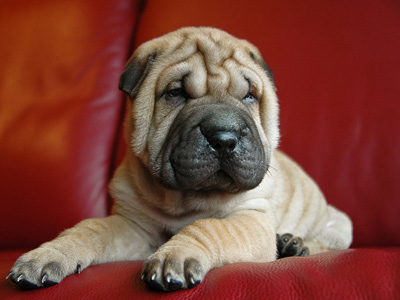
The Shar-Pei is a medium-sized and powerfully built dog, square in profile with a well-proportioned but slightly large head for the body. His appearance is very distinctive with loose skin covering the head and body — puppies have very wrinkled coats covering the head, neck and body but in general, the adult dog’s wrinkles are limited to the head, neck and withers — small ears, unique “hippopotamus” muzzle, and like the Chow Chow, the Shar-Pei has a blue-black tongue. (These are the only two recognized breeds with this characteristic.)
In character, the Shar-Pei is independent yet very devoted to his family. His protective instinct makes him an ideal watchdog as he is intensely loyal to his home and family and somewhat aloof with strangers. He is calm, dignified, intelligent, alert, and confident. Other words used to describe his temperament include: regal, lordly, sober, and snobbish.
The Shar-Pei’s coat is very harsh and straight. The coat’s length may vary from extremely short, “horse coat”, to no longer than one inch at the withers, “brush coat.” The coat can be any solid colour and sable. The solid colour dog may have shading down the back and on the ears.
Health Issues
Some of the more common ailments that affect the Chinese Shar-Pei are:
- Skin problems — One of the most common complaints of Chinese Shar-pei owners. There are a variety of causes, including: Demodectic Mange, allergies (both inhalant and food), and Cutaneous mucinosis.
- Hypothyroidism — A common complaint of all breeds. The thyroid gland is unable to function and maintain adequate levels of the various hormones needed to keep the body systems functioning. The commonest reason for hypothyroidism is thought to be “auto-immune thyroiditis”. This is when the dog’s own immune system turns on the thyroid gland and systematically destroys it.
- Entropion — When the excess skin surrounding the eye causes the eyelids to roll in and the eyelashes scratch the surface of the cornea. This constant irritation will ulcerate the cornea and unless treated can eventually lead to blindness in the affected eye. The Chinese Shar-pei’s deep-set eyes that tend to tear, is not necessarily a sign of a problem. Problem symptoms are eyes swollen shut and/or constant pawing and rubbing at the eyes. It should be noted that Shar-Peis eyes can be very sensitive to allergies and can swell shut due to environmental allergens (i.e., dust, cigarette smoke, etc.). This can give the appearance of entropion but surgery would not correct this problem.
- Cherry eye – Protrusion of the third eyelid — is another fairly common problem in the Chinese Shar-Pei. The gland for the third eyelid becomes unattached and can be seen as a round red blob in the inner corner of the eye. When large, it can actually obscure the entire eye. It does not hurt the dog or affect his vision; however, it is unsightly and can eventually cause problems if left untreated.
If you are considering the adoption of a Shar-pei puppy, or any breed, it is very important to be selective in choosing a responsible and reputable breeder. Ensure that the prospective puppy’s parents have all health clearances. Breeding of any dog should not be done until after they have been proven to be free of evidence of significant hereditary diseases. (For more information on selecting a breeder, see the articles on the General Information page.)
Recommended Health Screening:
For the Chinese Shar-Pei, the CHICNote 1 database includes health screenings for:
- Elbow Dysplasia
- Hip Dysplasia
- Patellar Luxation
- Autoimmune Thyroiditis
- Eye Examination by a boar Ophthalmologist
Additional Health Resources:
- Dr. Jeff Vidt — Indepth coverage of medical problems in the Chinese Shar-Pei.
- Health and Nutrition — Growing section of the Canada’s Guide to Dogs website which includes information on several health and nutrition related issues.
- Canine Health Information Center (CHIC) — Providing a source of health information for owners, breeders, and scientists that will assist in breeding healthy dogs. CHIC is a centralized canine health database jointly sponsored by the AKC/Canine Health Foundation (AKC/CHF) and the Orthopedic Foundation for Animals (OFA).
- AKC Canine Health Foundation — Working towards developing scientific advances in canine health.
- OFA – Companion Animal Eye Registry (CAER)
- Orthopedic Foundation for Animals (OFA)
- Ontario Veterinary College (OVC)
- University of Pennsylvania Hip Improvement Program (PennHip)
- HealthGene — HealthGene Corporation is the leading provider of veterinary DNA diagnostic services in Canada.
- Labgenvet — Laboratory of Veterinary Genetics is a Canadian diagnostic laboratory that offers a comprehensive service of DNA tests for veterinary genetic diseases.
Grooming Information
- Grooming — This section of the Canada’s Guide to Dogs website includes tips, articles and information covering all aspects of dog grooming along with a listing of Groomers from across Canada.
Training Resources
- Training — For training information, see this growing section of the Canada’s Guide to Dogs website for tips, articles, as well as listings of training centres across Canada.
Additional Information
- Feeding Your Shar-Pei
- Clubs, Sports & Activities — For information on the many sports and activities you can get involved in with your dog.
- Working Dogs — The Working Dogs section of the Canada’s Guide to Dogs website provides information and listings of organizations that are involved in various dog jobs, such as Guide Dogs, Therapy Dogs, Police Dogs, Protection Dogs, and much more.
*NOTE 1: CHIC – The Canine Health Information Center “is a database of consolidated health screening results from multiple sources. Co-sponsored by the Orthopedic Foundation for Animals (OFA) and the American Kennel Club (AKC) Canine Health Foundation, CHIC works with parent clubs to identify health screening protocols appropriate for individual breeds. Dogs tested in accordance with the parent club established requirements, that have their results registered and made available in the public domain are issued CHIC numbers.” To learn more, visit: www.caninehealthinfo.org
*NOTE 2: The Fédération Cynologique International (FCI) is the World Canine Organization, which includes 91 members and contract partners (one member per country) that each issue their own pedigrees and train their own judges. The FCI recognizes 344 breeds, with each being the “property” of a specific country. The “owner” countries write the standards of these breeds in co-operation with the Standards and Scientific Commissions of the FCI, and the translation and updating are carried out by the FCI. The FCI is not a breed registry nor does it issue pedigrees.
Breed Listing

Quick Links
Get In Touch
- Email: canadasguidetodogs@gmail.com
- Email: info@canadasguidetodogs.com
- Visit us on Facebook: www.facebook.com/CanadasGuideToDogs
— CanadasGuideToDogs.com is an Amazon Associate as well as a participant in various affiliate programs, as such fees are earned from qualifying purchases.